
Column
What is the transmissive type Photosensor (Photointerrupter)?The detailed explanation about features and implementation examples
Release date: 2026/03/25
Update date: 2026/03/25
The sensing technology that accurately detects the presence or absence and the position of the object is indispensable in automated industrial equipment lines, ATM and the amusement equipment.
Among them, “the transmissive type Photosensor” which achieves the high-accuracy and high-speed detection without the contact is an essential electronic component in the modern electronic equipment. It’s sometimes called as Photointerrupter.
In this article, we’re going to explain comprehensively about the basic principle of the transmissive type Photosensor, the technological strength such as the fast response and the high accuracy and specific implementation examples in fields of the industry, the medical and the finance.
Giving an example of the rich lineup of Shinkoh Electronics with over 50 years of experiences as a specialized manufacture of the Opto sensor, we’re going to introduce the best key points to select. Please refer this when you design and develop.
In addition, we, Shinkoh Electronics support customers in selecting the best product with one of the best selections of our items in the industry. We can provide the flexible support unique to a specialized manufacture such as the alternative suggestion of discontinued products, the fully customized reproduction and the additional processing on existing products.
Please feel free to contact us when you have troubles selecting the best model for your purpose.
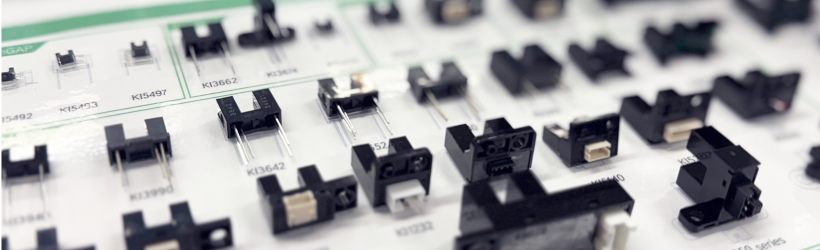
目次
- What is the transmissive type Photosensor?
- Features of the transmissive type Photosensor
- Key points to select the best product of the transmissive type Photosensor
- Purposes and implementation examples of the transmissive type Photosensor
- Features of the transmissive type Photosensor of Shinkoh Electronics
- Products of the transmissive type Photosensor of Shinkoh Electronics
- For your transmissive type Photosensor solutions, contact to Shinkoh Electronics
What is the transmissive type Photosensor?
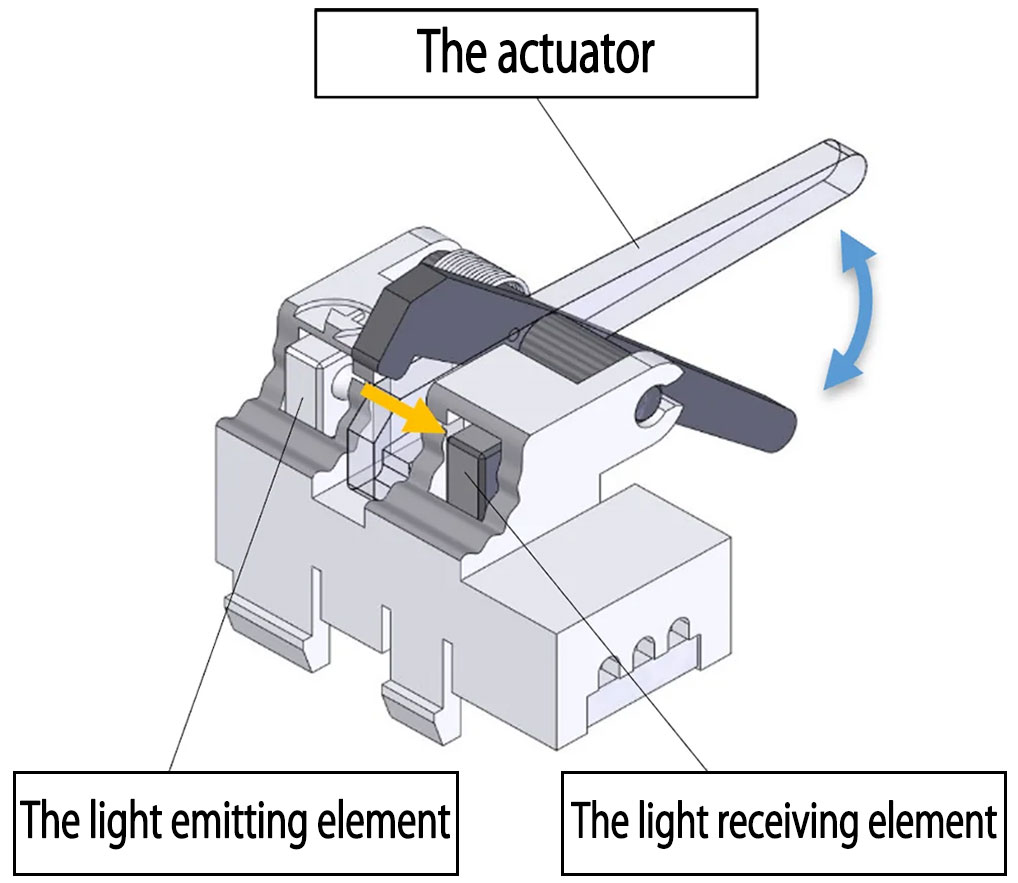
The transmissive type Photosensor is the Non-contact sensor that detects “the light obstruction” occurred when the object crosses between the light emitting element and the light receiving element placed facing each other.
It accurately captures the presence or absence and the passing of the object, the position and the number of the rotation by detecting whether the object blocks or passes the light path.
The lifespan is long because there’s no the mechanical contact and no wear of the sensor itself. In addition, it’s also a major feature that there’s no need to worry about damaging the object because it doesn’t contact the detection target object.
Though it’s generally called as “the transmissive type Photointerrupter” and “the transmissive type photoelectric sensor”, we’re going to provide explanations in this article standardizing the notation as “the transmissive type Photosensor”.
Component parts
- The light emitting element:IR LED is mainly used. It’s also called as the emitter and it irradiates the specific wavelength of the light to the opposing light receiving part. There’re output methods such as the always-on method and the method of lighting up in a strong pulse to the ambient light noise.
- The light receiving element:It’s also called as the detector and Phototransistor and Photo IC are used. It plays a role of receiving the light from the opposing light emitting element and converting the change in the light intensity into electrical signals.
- The slit:It’s the physical opening on each front of the light emitting part and the light receiving part. It enables the detection of small objects and increases “the resolution” indicating the fineness of the detection position by narrowing the area where the light passes.
The basic principle of the detection
The detection mechanism is very simple and it uses whether the object blocks the path of the light from the light emitting part to the light receiving part or not.
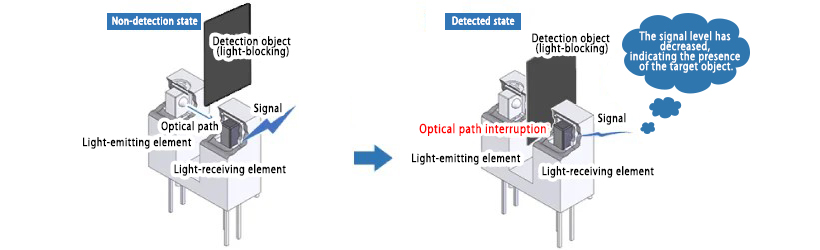
- 1.Light ON (in the absence of any object): It’s the situation that the light from the light emitting element reaches to the light receiving element without being blocked. The light receiving element detects the light and outputs the specified signal (e.g. Low level).
- 2.Dark On (in the presence of the object): It’s the situation that the light is blocked when the object enters between the slits. The electrical signal switches (Switching) when the light doesn’t reach to the light receiving element and notifies the passage and the presence of the object.
This clear ON/OFF operation achieves the reliable detection while being non-contact.
Differences from the mechanical switch
The limit switch and the micro switch open and close the circuit when the object contacts.
- The mechanical type:It has a limited lifespan because there’s the wear due to the contact. The chattering (vibration) elimination is also required.
- The transmissive type:It can be used semi-permanently because there isn’t the wear due to the non-contact. It’s superior to the fast response.
Features of the transmissive type Photosensor
The transmissive type Photosensor has superior features especially in “the response time” and “the position accuracy” compared with the limit switch involving the physical contact and other Opto sensors including the reflective type.
We’re going to explain in detail about the main technological advantages adopting the transmissive type Photosensor.
The fast response
It’s possible to track the high-speed movement that the mechanical switch isn’t capable because it transmits signals at the speed of the light. Especially the digital output type adopting “Photo IC” being integrated the signal processing circuit to the light receiving element achieves the ultra-high-speed control in microsecond (us).
You can see its high-speed referring the data sheet of “KI5230” which is the Photo IC output type of Shinkoh Electronics’s products.
| Product name | Output format | Rise time (Low to High) |
Fall time (High to Low) |
|---|---|---|---|
| KI5230 | Photo IC (digital) | 1.47 μs (Typ.) | 0.02 μs (Typ.) |
Data source: KI5230 – The Opto sensor, the Photosensor, the data sheet
These numbers mean the response in 1 millionth of a second. This high speed greatly contributes to shorten the takt time and improve the production efficiency in cases such as the controlling the rotation speed of the high-speed motor (the encoder usage) and the passing detection of the high-speed workpiece moving through the production line.
In addition, it’s a major advantage that it can always receive the clear signal even during the high-speed operation because there are no wear and no bounce (vibration) unlike the mechanical switch.
The high accurate detection position
The transmissive type Photosensor detects through “the slit (aperture)” which is physically narrowing the light unlike the reflective type. This makes capturing the object edges with the extreme accuracy possible.
- The high repeatability: There is almost no deviation in the output signal no matter how many times it detects because “the moment of the light-blocking” when the object crosses the light path is obvious.
- The detection of subtle objects: It can identify small objects less than a few millimeters and the position of workpieces on the plate with the high resolution by narrowing the slit width.
This feature is an essential element for the mechatronic equipment required the detection accuracy of about 0.1mm such as the ATM bill transport and the position control of the print head.
The high durability by the non-contact detection
It doesn’t have the wear of sensor itself and has a long life because it can detect the detected object without the contact. No deterioration of contacts is occurred like the mechanical switch.
In addition, it’s also suitable for the detection of the fragile film, the light paper and the precision component because no physical stress is applied on the object.
Key points to select the best product of the transmissive type Photosensor
There’re many transmissive type Photosensors in the market, but if you select the product which isn’t suitable for your purpose, this may cause malfunctions or detection errors. In order to narrow down the options to the best product, let’s proceed with the 3 axes, “the shape”, “the output format” and “the environmental performance”.
| Selection criteria | Points to check |
Specific product examples (made by Shinkoh Electronics) |
|---|---|---|
|
Shape (gap, slit) |
“The gap width” which is wider than the thickness of the detected object is necessary. We recommend you to select the generous size considering the shaking during the
|
|
|
Output format (costs and functions) |
|
|
|
Environmental performance (dust-proof, splash-proof) |
|
|
The blocking the light path by “the paper dust” can be a major cause of the malfunction of equipment handling the paper especially like ATM and the printer. In these situations, adopting the “completely dust-proof type” that the light emitting/receiving surface are covered by the flat resin and the garbage doesn’t easily accumulate is standard is standard.
Purposes and implementation examples of the transmissive type Photosensor
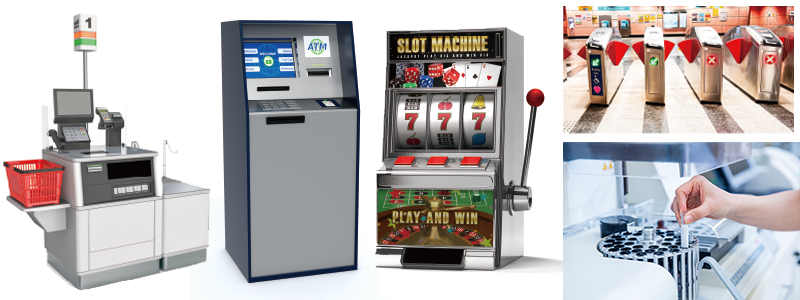
The transmissive Photosensor is embedded in a wide range of the critical equipment supporting the social infrastructure such as the industrial equipment, the amusement equipment, the medical and the financial equipment. We’re going to introduce specific implementation examples in each industry here.
The industrial equipment
In the factory automation equipment, the transmissive type Photosensor works as “the machine eye” and supports the accurate control.
- The detection of the mechanical origin, the limit detection: It detects that the linear actuator and the robot arm are return to the home position and that the limits of the range of the motion is reached with non-contact. The high repeatability of the position detection improves the accuracy of the machine operation.
- The detection of the motor rotation:It’s used for the speed adjustment and the position control of the drive motor of the belt conveyor for transporting workpieces. The fast response type (Photo IC) is commonly used.
The amusement
In the amusement equipment such as the pachinko and the slot machine, many photosensors are used in order to the fraud prevention and the performance.
- The detection of the reel rotation:It’s used for the accurate track of the rotational position of the image drum (reel) of the slot machine. The control to stop the image at the desired position is available by the high accuracy of the position detection.
- The detection of the door’s opening/closing: It detects that the maintenance door is opened and activates the security alarm.
- The passage detection of medals and balls: It fast and accurately counts passages of medals and pachinko balls thrown in and conducts the dispense control. The dust-proof type sensor is frequently used due to the environment with the vibration and many dust.
The medical equipment
In medical fields that affect human lives, the non-contact, being hygienic and the high reliability where malfunctions are not tolerated are required.
- The detachment detection of each unit: It’s used for the confirmation that the unit such as test tubes and reagent cassettes is set up correctly in the sample testing equipment.
- The detection of the mechanical position: It’s used for the positioning control of the transfer arm and the stage inside the analyzer.
- The detection of the presence or absence of sample containers: It detects the transparent container like the test tube and the presence or absence of the liquid inside.
The financial equipment
In the financial equipment such as ATM and the money changer, Photosensor is essential to handle bills and coins accurately.
- The detachment detection of each unit: It detects whether the currency cassette is loaded correctly.
- The control of the bill transport: It detects the timing of the bill passage and the jam (paper jam). The dust-proof type sensor is required to prevent malfunctions by the paper dust from bills.
- The foreign object detection: It confirms whether there’re no foreign objects in the slot and prevents troubles in advance.
Other purposes
Beyond the industrial use, the transmissive type Photosensor is used in a wide variety of equipment.
- The simple encoder: The slit disk (code wheel) is attached to the motor shaft and its rotation is read by the Photosensor to control the number of revolutions and the speed. The digital output type (Photo IC) has the fast respond speed (us order), so the control of high-speed rotating motors is available.
- he detachment detection of each unit: It’s widely used in everyday products. For example, the confirmation of setting of the toner bottle and the paper tray of the OA equipment (printer, etc.).
Please select the best product according to the space and the environment of the place of your use.

Features of the transmissive type Photosensor of Shinkoh Electronics
When selecting the transmissive type Photosensor, we would like to consider the product lineup of a specialized manufacture of the Opto sensor, “Shinkoh Electronics”, as one of the options. Our expertise cultivated over 50 years and a wide variety of products responding various needs support the design problem solving.
The industry’s largest lineup
In “KI series” of Shinkoh Electronics, there’re so many choices of the width and the mounting shape of the detection gap. You can carefully select the best model according to the size of the object and the limited space in the equipment.
- The wide range of gap settings:It supports from 2mm to 15mm. Especially products with the wide gap which is 10mm or more (KI1215, KI1223, KI1248 and etc.) surpass other company’s products when detecting thick workpieces.
- Various mounting shapes
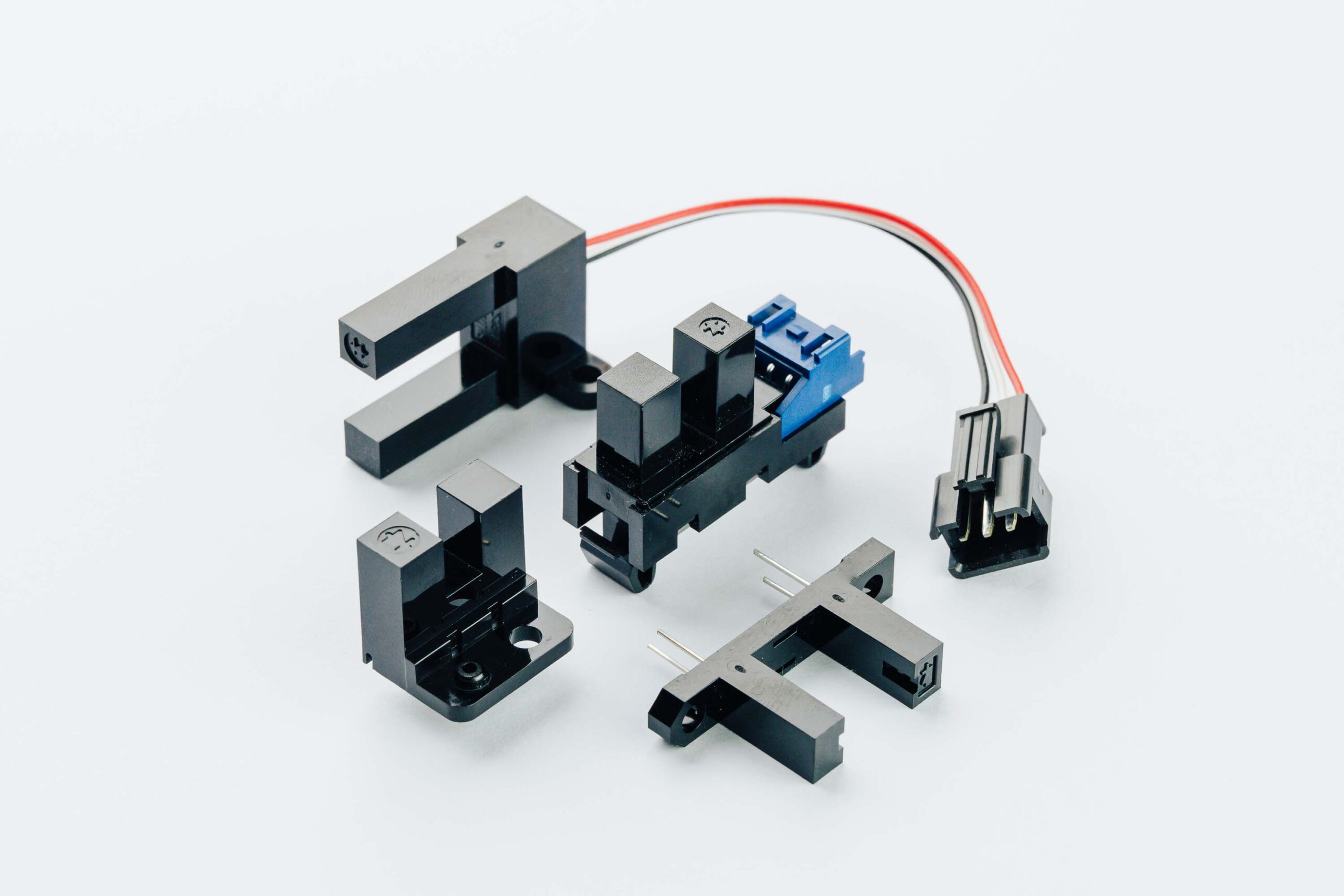
・Directly attached to the board: The type that is soldered and fixed and is suitable for downsizing of the equipment (KI1221 and etc.)
・The connector: The easy to maintain and wiring labor-saving type
・The screw fastening: The type that can be firmly fixed to the housing through the flange (KI1138 and etc.)
・The snap-in: The one-touch type that can be simply fixed by pushing into the hole in the sheet metal. (KI3024 and etc.)
There’re also models for harsh environments. “The completely dust-proof type (KI5774 and etc.)” that is resistant to the paper dust and dirt and “the splash-proof type (KI3700 and etc.)” that is available even under the environment with water droplets are standardized.
The flexible customization
Shinkoh Electronics flexibly customizes even for special requirements that can’t be met with standard products alone. We’re proud of our careful support by engineers with extensive knowledge of the Opto sensor.
- 1.The optimization of features:We individually adjust the detection sensitivity and the response time according to the usage environment.
- 2.Changes in the shape and the specification: We can change the position of mounting holes, support for special cable lengths and change to the specified connector.
- 3.The assembly provision: We make proposals to reduce customer’s assembly man-hours by the cable crimping and the delivery with the board mounted.
We also can support “the replacement for discontinued products from other companies”. We propose the best solution for your needs by from suggestion of equivalent products to the reproduction development with fully customizing.
Products of the transmissive type Photosensor of Shinkoh Electronics
We’re going to explain the related product information that helps to select the transmissive type Photosensor of Shinkoh Electronics and the terminology for your reading of the specification.
The list of main products of the transmissive type Photosensor of Shinkoh Electronics (KI series)
The transmissive type Photosensor of Shinkoh Electronics features a variety of shapes designed for purposes such as “the dust-proof type”, “the wide gap (wide)” and “the high accuracy (narrow slit)”.
The main specs and features described in the data book are summarizes in the table below.
| Name of series | Gap width | Slit width | Output format | Connection method | Main features and purposes |
|---|---|---|---|---|---|
| KI1138 | 5mm | 0.5mm | Photo IC | Connector | [The dust-proof, 2 optical axes] 2 optical axes are built into 1 sensor. It’s frequently used in the amusement equipment. |
| KI1232 | 5mm | 0.5mm | Transistor | Connector | [The dust-proof, analog] The cost performance is great and it’s ideal for dusty |
| KI3110 | 5mm | 0.25mm | Photo IC | Connector | [The high accuracy] It’s ideal for the detection of subtle objects and the high-accuracy positioning. |
| KI1215 | 13mm | 2mm | Photo IC | Connector | [The wide gap] It’s for thick objects and the conveyor line. |
| KI1223 | 15mm | 2mm | Transistor | Directly attached to the board | [Super wide] 15mm gap, the largest in the industry. |
| KI3700 | 8mm | 0.5mm | Photo IC | Lead wire | [Dust-proof and splash-proof] IP64 equivalent. It’s for vending machines and medical equipment. |
| KI1300 | 8mm | 0.8mm | Photo IC | Connector | [Medium wide, the high accuracy] The type balancing the accuracy and the |
| KI5230 | 5mm | 0.5mm | Photo IC | Connector | [Small size, with the lock] It’s stable even under the vibration environment. |
| KI3780 | 5mm | 0.5mm | Photo IC | Connector | [Snap-in] No screws are required and it reduces man-hours. |
※Data source:The transmissive type Photosensor
We hope this helps you to select the best products referring to the gap width (2mm to 15mm), the mounting shape (directly attached to the board, the connector and the screw fastening) and the output format.

The terminology guide
We’re going to explain the terminology used in the table and the specification.
1. The terminology about the structure and the function
There’re terminologies about the physical form of the product and Shinkoh Electronics’s unique packaging structure.
| Terminology | English notation | Explanation and features of Shinkoh Electronics’s products |
|---|---|---|
| Detection groove width (gap) |
Gap |
It’s the distance between the light emitting part and the light receiving part. The objects that are thicker than this width can’t pass through. There’re a wide range of the industry’s largest wide gap products such as 13mm (KI1215) and 15mm (KI1248) in addition to standard 5mm. It’s possible to the thick workpiece and conveyance items in the random position. |
| Slit width | Slit Width |
It’s the width of “the window through which the light passes” inside the sensor. The lower value enables the better detection of thin objects and the slight misalignment. Though the standard is 0.5mm, the high-accuracy model KI3110 adopts 0.25mm and realizes the extremely high position detection accuracy (resolution). |
| Dust-proof (completely dust-proof) |
Dust Proof |
It’s the dust-proof type covering the light emitting/receiving surface with the double-layered structure of the case cover and the detection slit. It prevents malfunctions caused by the intrusion of the paper dust and the dust. KI1233 (dust-proof) and KI5774 (completely dust-proof) are expended for ATM and ticket vending machines. |
| Visible light cut | Visible Light Cut |
It’s the black resin package that blocks the visible light such as the sunlight and fluorescent lights and passes only IR. It reduces malfunctions caused by the ambient light and it’s adopted as the standard in most products of Shinkoh Electronics. |
2. The terminology about electrical characteristics (input/the light emitting part)
There’re symbols described in “the maximum rating” of the data sheet and “the electro-optical features” of the input part (LED part).
| Terminology | Symbol | Points of explanation and design |
|---|---|---|
| Forward current | IF | It’s the current value to light emitting part (LED). The higher this current is, the stronger the light is emitted. Though the rating (the maximum value) is usually around 50mA, it’s common to use around 10mA to 20mA (derating) in the actual design considering the lifespan. |
| Forward voltage | VF | It’s the voltage drop occurred when the current (IF) flows through LED. IR LED of Shinkoh Electronics is approximately 1.2V (Typ.). It’s used for the calculation of the current limiting resistor by subtracting this value from the power supply voltage. |
| Pulse forward current | IFP | It’s the maximum value of the large current that can be passed for a very short time (pulse). It’s used for remote control applications where the instantaneous strong light is required and the operating at intervals to save energy. About 1A is normally allowed |
3.The terminology about electrical characteristics (output/the light receiving part)
There’re important terminologies related to signals from the sensor. There’re different things to look at depending on “Phototransistor output” or “Photo IC output”.
In case of products of Phototransistor output (analog) For example: KI1221, KI1232 and etc.
| Terminology | Symbol | Points of explanation and design |
|---|---|---|
| Photocurrent | IC / ISC | It’s the current flowing to the light receiving part when the light enters to the sensor (Light ON). The larger this value is, “the better the sensitivity” can be said. In the circuit design, the load resistance is selected so that the voltage definitely drops at this current value. |
| Dark current | ICEO | It’s the leakage current flowing to the collector when the voltage is applied between the collector and the emitter in the dark. You should confirm the graph “dark current – ambient temperature features” in the specification because it tends to increase in high-temperature environment. |
| Collector-Emitter saturation voltage | VCE(sat) | It’s the minimum voltage occurred between the collector and the emitter when the transistor operates in the saturation region. It’s usually 0.4V or less. This value needs to be lower than the low-level input voltage (VIL)” of the downstream microcontroller and the circuit. |
In case of products of Photo IC output (digital) For example: KI3110, KI5530 and etc.
| Terminology | Symbol | Points of explanation and design |
|---|---|---|
| Power supply voltage | VCC | It’s the voltage required to operate the sensor. The range is usually specified such as 4.5V to 5.5V and 4.5V to 17V. |
| Low-level output voltage | VOL | It’s the voltage when the sensor outputs “Low”. It’s usually 0.4V or less. You should confirm that this value is less than the microcontroller threshold when connecting directly to the microcontroller. |
| Response time | tr,tf | It’s the time (lag) from detecting the object to switching the output. Photo IC type is very fast and it’s suitable for counting coins and bills passing through at the high speed because products like KI1138 of Shinkoh Electronics response on the order of a few microseconds (us). |
| Pull-up resistor | - | It’s the resistance to make the voltage of the output terminal stable. In products of Shinkoh Electronics, there’re 2 types, the type that this resistor is already built in (easy wiring) and the open-collector type that the external is required (the voltage level can be freely set). |
4. The environmental performance and others
| Terminology | Explanation |
|---|---|
| Operating temperature range (Topr) | It’s the temperature range ensuring that the sensor is working properly. Most industrial types of Shinkoh Electronics support a wide range from -20°C to +85°C. |
| Soldering temperature (Tsol) | It’s the limitation of the temperature and the time when soldering the terminals to the board. The internal elements may be damaged by the heat if we don’t follow this. (e.g. 330°C or less, within 3 seconds and etc.) |
You will select the best sensor according to purposes (“what”, “where” and “How often” you want to detect) referring these terminologies and product’s line up.
For your transmissive type Photosensor solutions, contact to Shinkoh Electronics
The transmissive type Photosensor (Photointerrupter) has great features such as the high accuracy, the fast response and the non-contact. It’s widely used from the industrial equipment to automated machines in our daily life.
To select the best sensor, it’s important to select the appropriate gap width and output format considering not only the size and the material of the detected object but also the usage environment such as the installation space, the dust and the ambient light.
Shinkoh Electronics is “the professional of the Opto sensor” responding customer’s various needs with the industry’s largest lineup, the high-reliability technology such as the dust-proof and the splash-proof and the flexible customization.
Please feel free to contact Shinkoh Electronics when you have troubles such as “What product should I select” and “I have troubles because the existing sensor is discontinued”. We would like to propose the best solution based on our extensive knowledge.
-
2026/03/25
What is the Non-contact sensor?
The detailed explanation about constructions, types, advantages of utilization and features of the Opto sensoracademy
-
2025/12/10
What is Opto sensor
academy
- Column Category
- Tags
- Recommended Articles
-
-
2026/03/25 What is the Non-contact sensor?
The detailed explanation about constructions, types, advantages of utilization and features of the Opto sensor -
 2026/03/25 What is the transmissive type Photosensor (Photointerrupter)?The detailed explanation about features and implementation examples
 -
2025/12/10 What is Opto sensor
-
